Showing posts with label Urbanism. Show all posts

paris map

"Ten years ago [sic], the photographer Paola Di Bello recomposed the Paris subway map into a collage of hundreds of small colour photographs. Each shows the spot on the locator maps one finds in every metro station where passengers place their fingerand think, “So, now I’m here.” The result is an unusual map showing Paris as a vital world. A world where major transport hubs and popular places are erased or faded by the touch of countless fingers. Di Bello’s collage is an atlas of Parisian tourism. A particular kind of atlas, in which the impersonal code of classical cartography and thousands of subjective acts are juxtaposed. Not unlike a DJ’s remix, the routes of the metro tracks are layered with the movement of the bodies that travel along them. This atlas of the Parisian subway tells of an eclectic geography, made up of daily routines, tourist sites, brief stops, corridors of flow, forgotten areas, solitary places. It is a geography, not only of spaces, but also of tempos and movements, surprisingly similar to our way of thinking about the contemporary city. Today, atlases in this mode are needed more than ever, not just as a compendium of data, but also as a representation."

in Domus 870 - May 2004.

Read More

404 Festival Taiwan 2010 / Official Spot


The Festival 404, born in the city of Rosario in December 2004, is an independent non-profit organization whose main objective is to promote and spread artistic productions around the world in the field of electronic art, generating a production environment in which the authors are interrelated.
According to the organization, "the '404 Festival Taiwan 2010 / Official Spot' film investigates the genesis of a world created from information where success and failure becomes layered into an evolving urban landscape. This city is not designed through intentional desires, but rather by the proliferation of ideas and thus equating failure with success, each becomes their own thread in a tapestry of an evolving construct." This is so obvious that sometimes people forget it. It is very nicely put though. As is their manisfesto:
ERROR IS CREATION
MANIFESTO TAIWAN 2010
By Gina Valenti

We live in a system that allows mistakes only when the solutions can be found solely within it.
We live in a system to which we must abide by, except when we make art.

I've always dreamt with a world that doesn't fear to make mistakes, never about one that flaunts the fact of being right.

In a historical moment that privileges the appearance of new devices,
people have easily become used to assimilate ideas which haven't been conceived to be their own, when actually thoughts should be newer than the novelty.

Those who believe to be part of a large audience, think of technological means as the only way not to fall behind, ignoring that this behaviour is the worst way of moving forward, only delaying the invention of our next bonfire.

In error lies a combination of possibilities that avoid function. This is a quality shared with art, and its residual value consists in being unuseful, in its lack of practicity.

Error bursts onto the scene.
Objects fail on purpose, forcing us to contemplate their inherent creative nature.

The main purpose of every object is to fail, and by doing so, they turn into something more complete: the result of what we do and do not expect. It becomes a new object, with new features, that will travel through the path that maximizes it.

In a world where thinking is considered erroneous, thinking becomes a duty.
Error is creation.

You should really go to their website and check out the artists page. It is loaded with videos and other goodies. Here a sample of what you might find:


And remember: embrace the unintended consequences.

P.S. I just still haven't figured out why the slogan is spoken in Portuguese… "festival quatro zero quatro, o erro é criação, o mesmo número um sítio novo, taiwan 2010"…
Read More

social life of small public spaces


Repost from Urban Planning Blog
Read More

berthier's door

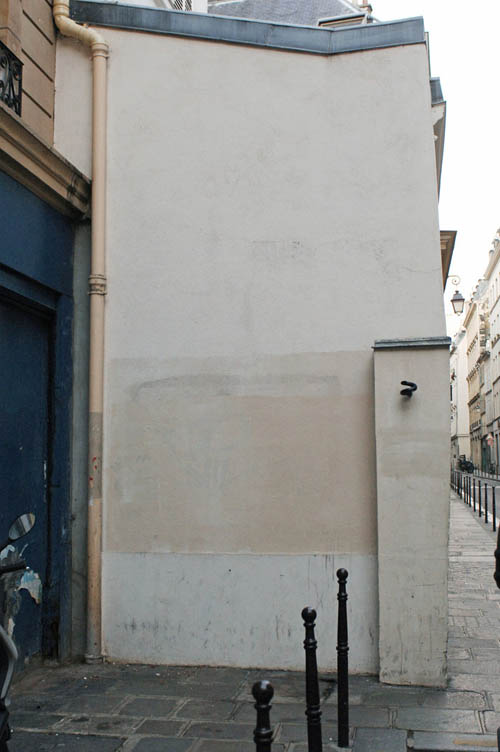
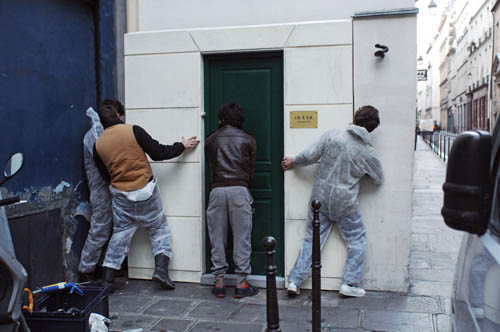
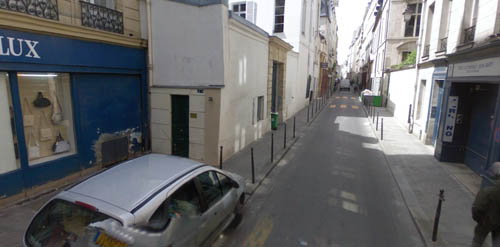
The story of how a fake door became real, no questions asked, to the city of Paris. Read in BLDGBLOG.
2006

Read More

Harvey Zeitgeist

The logic of capital accumulation and class priviledge through hegemonic, can never control every nuance of urbanization (…). David Harvey - New Urbanismand the Communitarian Trap. In Harvard Design Magazine Nº1 (1998).

Strangely this is the same message of Zeitgeist Addendum.

Also hear and "see" David Harvey on the Crisis of Capitalism:


Geographer and sociologist, David Harvey wrote: Justice and the City (1973), The Condition of Postmodernity (1989), Social  e Spaces of Hope (2000).
Read More

narrow my streets

David Yoon is a photographer, "writer, designer, and urban planning geek" - he says it himself. He creates, in his blog, a what if? universe centering on Los Angeles. He envisions and visualizes how LA would look like if its streets were narrower. Hence the appropriate name: narrow streets: los angeles.

And without further ado, I present thee the concept of UCHRONIA.
In the words of Foucault "Fist there is Utopia". Borrowing from Harvey, talking about Moor's Utopia or Bacon's Atlantis, "[all] these forms of utopia can be characterized as 'Utopias of spacial form' [in opposition to 'Utopias of social process'] since the temporarily of the social process, the dialectics of social change - real history - are excluded, while social stability is assured by a fixed spacial form."
If, one considers time in the same sense as process, one would feel tempted to say that "utopias of social processes" are essentially Uchronias. But, again, Harvey explains that, in the later case, the qualities of space and place are totally ignored".
Then, Uchronia has the same sense as utopia of temporal play, because instead of suspending time in favor of space, it suspends space in favor of time. Makes sense? It does, so as one acknowledges that any social process has effects both in time and place. It should be noted that these all are to be treated as "ideal types". So, what if, in opposition to utopias of social process, we were to group utopias of spacial AND temporal play? Now, what DOES David Harvey think of this?

Read More

Narrative Architecture, Game and Theme Park Design

Don Carson, who worked as a Senior Show Designer for Walt Disney Imagineering, has argued that game designers can learn a great deal by studying techniques of “environmental storytelling,” which Disney employs in designing amusement park attractions: “The story element is infused into the physical space a guest walks or rides through. It is the physical space that does much of the work of conveying the story the designers are trying to tell [...]. Armed only with their own knowledge of the world, and those visions collected from movies and books, the audience is ripe to be dropped into your adventure. The trick is to play on those memories and expectations to heighten the thrill of venturing into your created universe” 
 JENKINS, Henry - GAME DESIGN AS NARRATIVE ARCHITECTURE.

Read also:  CARSON, Don - Environmental Storytelling: Creating Immersive 3D Worlds Using Lessons Learned from the Theme Park Industry.
Read More

tourist open season

Visualisations from Eric Fisher detailing concentrations of tourists in cities around the world, using geotagged photos. Blue are photos taken by locals. Red by tourists. Via Information is Beautiful.

Oslo
 Paris
 Roma
 Barcelona
 Copenhaga
more after the break or on Eric Fisher's

Read More

dreamlands


Présentée dans la grande galerie du Centre Pompidou du 5 mai au 9 août 2010, l'exposition Dreamlands développe un propos inédit : montrer comment les modèles de foires internationales, d'expositions universelles et de parcs de loisirs ont influencé la conception de la ville et de ses usages.
Démultipliant la réalité par la pratique de la copie, jouant d'une esthétique de l'accumulation et du collage souvent proche du kitsch, ces mondes clos et parallèles ont en effet inspiré les démarches artistiques, architecturales et urbanistiques au XXe siècle, au point de s'ériger en possible norme de certaines constructions contemporaines.

Cette exposition pluridisciplinaire rassemble plus de trois cents œuvres, mêlant art moderne et contemporain, architecture, films et documents issus de nombreuses collections publiques et privées. Dans une mise en espace ludique et didactique à la fois, elle propose la première lecture d'envergure de cette question et conviera à s'interroger sur la manière dont s'élabore l'imaginaire de la ville et dont les projets urbains s'en nourrissent.

Expositions universelles, parcs d'attractions contemporains, le Las Vegas des années 1950 et 1960, le Dubaï du XXIe siècle : tous ces projets ont contribué à modifier profondément notre rapport au monde et à la géographie, au temps et à l'histoire, aux notions d'original et de copie, d'art et de non-art.

Les « dreamlands » de la société des loisirs ont façonné l'imaginaire, nourri les utopies comme les créations des artistes, mais ils sont aussi devenus réalité : le pastiche, la copie, l'artificiel et le factice ont été retournés pour engendrer à leur tour l'environnement dans lequel s'inscrit la vie réelle et s'imposer comme de nouvelles normes urbaines et sociales, brouillant les frontières de l'imaginaire et celles de la réalité. Du «Pavillon de Vénus» conçu par Salvador Dalí pour la Foire internationale de New York de 1939, au «Learning from Las Vegas» (L'enseignement de Vegas) des architectes Robert Venturi et Denise Scott Brown, et au «Delirious New York » de Rem Koolhaas (qui souligne la filiation entre Manhattan et le parc d'attractions de Dreamland), les seize sections de l'exposition retracent les étapes d'une relation complexe et problématique.
Read More

mapping

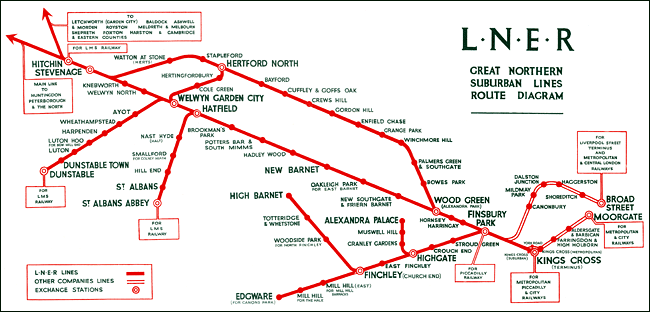
Cartography has been a part of mankind since its beginning having a history of up to 8.000 years. The debate about the first map relies upon the definition of map. Mapping became increasingly important as space grew in complexity. It culminated in the abstraction of the Transit Map. This topological map in the form of a schematic diagram, unlike conventional maps, is not geographically accurate illustrating a fixed distance between points, compressing those in the outer area of the system and expanding those close to the center. The abstraction of rout-maps for individual transit lines can be traced back as early as 1908, but it was George Dow who, for the first time, launched a diagrammatic representation of an entire rail transport network (in 1929), followed by Harry Beck's iconic London Underground Map in 1933.

With the advent of modernity things got even more complex as the concepts of time and space became intertwined. "Space-time compression" became a platitude in the debates on post-modernity and post-modernism. As space takes over place, and as both time and space get diluted into each other, one can begin to feel "lost in space", as Wigley noted. Time, not distance, has become the most importante criterion on determining the spacial organization of the various parts composing (post)urban landscape. Paul Virilio, who analyzed modernity's fascination with speed, has argued that modern transportation's speed is the most important factor in the current disurbanization process. Categories like time and speed undermine the geographical identity of a city. Koolhaas added to this discussion, when talking about Euralille in the "Beyond Delirious" article, that "[if] you imagine not distance as a crucial given but [the] time it takes to get somewhere then there is an irregular figure which represents the entire territory that is now less then one hour and thirty minutes from Lille" (Nesbitt, 1996: 334) (read here).


That must have been what Xiaoji Chen thought. She (re)searched into irregular or distorted maps of Paris as a way to depict one's mental map of the city, which she says "is not measured in miles". After abstraction comes the "baroque" (not a pejorative). Xiaoji made what she calls "isochronic maps" [sic] of Paris under different transportation modes. It can be seen in the car based map how "the city center expands from congestion, and the edge is denser". If you add eco-concerns to the equation you get yourself the basis to a whole lot of possible services. The video shows how the map transforms itself when time and carbon footprint go into play.

Read More

"productive dystopia"

Urbanity is a psychopath sedated on drugs and reeducated to tell the right anecdotes at the right dinner parties. All the while outside of the radar of the regeneration industries is the blood, guts, sweat, tears, people smiling, spontaneous celebrations, street car drag-racing, squirrel bashing, basement perversions, road vivisectionists and black tie swinger parties that constitute a big part of the real living city.

Darryl Chen in Tomorrow's Thoughts Today

Read More

logorama

Logorama ganhou o Oscar para melhor curta animada.


O fantástico "atelier" francês de design H5 já fez a direcção artísticas para muitas marcas da moda, joelharia, perfumes; fizeram a edição gráfica do catálogo para Le Grand Paris; realizaram diversos videoclips para Alex Gopher, Goldfrap, Røyksopp, Massive Attack, etc; realizaram anúncios como este e o da Citroën; e recentemente realizaram uma curta que foi nomeada para os Oscares chamada Logorama.
Read More

habitares


A regionalização, a condição fronteiriça na paisagem europeia actual e a questão da inclusão de Portugal em território espanhol, são assuntos que me interessam, e sobre os quais gostaria de me debruçar mais seriamente. Ouvi hoje na rádio a pela VCI fora - não me lembro qual a emissora - uma entrevista na qual se discutia o Agrupamento Europeu de Cooperação Territorial (AECT) Galiza-Norte de Portugal. Trata-se do modo mais eficiente de captação de fundos comunitários a serem injectados directamente nos territórios em questão, uma vez que fundos destinados a euro-regiões, pela União Europeia, não passam pelos governos centrais.
Neste seguimento, ao visitar o site do Foro Internacional Ciudad, Terriorio y Urbanismo (CITUR) - já agora aviso que a publicação que decorre deste evento, Ciudad de Nuevo Global, desapareceu da biblioteca da FAUP duas semanas depois da estreia - tropecei pelo site Habitares - Las Ciudades de los Ciudadanos que tem o seguinte índice:

00. CIUDADES

01. SENTARSE/ESTAR # ser ciudadano
02. NO-HUMANOS # de las sociedades a los colectivos híbridos
03. EXPRESAR/MEDIAR # crear opinión pública y ampliar la democracia
04. PUERTAS # interfaces de conexión arquitectura-ciudad
05. TURISMO # construir y vivir el simulacro
06. MIRAR/PASEAR # descubrir la ciudad y encontrarse con el otro
07. MULTITUD # superficies, líneas y puntos de congregación
08. DOMESTICAR/RESIDIR # vivir el espacio público
09. INTIMIDAD # los rincones de la ciudad-mundo
10. OKUPAR/SUBVERTIR # distorsiones en la programación urbana
11. RESIDUOS # lo sobrante y el deterioro en producción continua
12. CONDENSADORES # vidas públicas en espacios privados
13. OCIO # actividades innecesarias en paisajes ineficaces
14. MERCADO # polisemias, coincidencias y cinismos
15. EFÍMERO # grados de construcción del acontecimiento
16. MOVIMIENTO # objetos y sí-lugares en un espacio-tiempo inquieto
17. CONTROL # captura y puesta en escena del poder
18. FACHADAS # pieles que sudan ciudad

---

LUCIANO G. ALFAYA + PATRICIA MUÑIZ _ habitares. ciudades simultáneas
IAGO CARRO / ERGOSFERA _ la ciudad al habla... ¿hay alguien ahí?
XAVIER COSTA _ espacios de consumo
FRANCISCO JARAUTA _ el laboratorio de la ciudad
NUNO GRANDE _ los nuevos mapas de la ciudad contemporánea
ANDRÉS JAQUE _ de la ciudad sincronizada a la ciudad parlamento

É possível fazer o download individual de cada um dos artigos. Ou então, eu disponibilizo um link para um pdf onde os compilei a todos AQUI.
Read More

Tokyo Night Drive

Going through my blog roll I found the following video called Tokyo Night Drive, created by youtube user called cat252jp. It reminded my instantly of Pedro G's epitome of all things urban - Four Tet's She moves She.


Read More

solid ground

Ms. John Soda: Solid Ground

Read More

RUA - Cidade e Cinema

Deparei-me com uma revista brazileira intitulada de RUA - Revista de Urbanismo e Arquitectura. Não percebi se já acabou ou não, mas parece que sim. O último número a aparecer no site trata da "relação visceral entre CIDADE e CINEMA". É das cidades dos cinema ou do cinema das cidade que se escreve, partindo de um um fascínio mútuo entre o campo do cinema e o da cidade, estabelecido desde as primeiras experiências dos irmãos Lumière e que permanece até hoje.

Todos os artigos, entrevistas e resenhas estão disponíveis para download em PDF. Altamente recomendáveis alguns deles. Convido à leitura.
Read More

L'Enjeu Capital(es)


Read More

under construction #1

Read More

Productive Dystopias


Or... An Architecture of Unintended Consequences

Utopia

Failed utopias are easy targets for tabloids, cynics and pragmatist alike. Corbusier’s Radiant City, Ebenezer Howard’s Garden City, the Amish Village, and the benign dictatorship of Butan – utopias seems more dysfunctional than functional, more flaw than awe. Is it no surprise that we’ve stopped believing in them? Insight is 20/20 vision. “I told you so” - the future critiquing the past. But if we’ve abandoned the utopian project, if so few of us believe in it, than where do we find hope? The failure of utopia, it could have been a trigger for a lack of nerve. But instead of retreating into conservatorism, a moderation of our desires and ingenuity, we ask the question: does dystopia offer a viable alternative? Dystopian visions offer us compelling imagery, from Ballard to Blade Runner, from Brazil to brutalism, the terrifyingly beautiful – the sublime is always more potent than the picturesque. Dystopia is often a utopia, except for one fatal flaw that undermines the whole scenario. That one flaw is a reality check to our most idealistic dreams - a peaceful world where people live blissfully until being exterminated at the age of 30; a perfect world that’s been totally fabricated for primetime TV; a perfect world populated by perfectly compliantly blemish free women that happen to be robots; a perfect world when thought is controlled by a central agency.

Design is always a projection into the future. Always, by its nature, positive, always with a utopian impulse - from the building that will bring joy to it’s employees to a seat that can cushion one’s ass in style. What if we subject that design impulse to one wrong thing, one misfortune, one unintended consequence? What do we learn from a design gone wrong? Wrongness in this sense is not the opposite of right. A dysfunction can take on many colors. An object might not just cease to function, it may indeed permute functions and applications. Piracy offers a radical redistribution of product according to new codes of etiquette, licensing and responsibility. Hacking takes existing systems and subjects them to reprogramming, to novel alternatives and usually subversive ends. Cheating subverts the rules of a given regulatory system to the advantage of those with ingenuity, technique and shear audacity. Rules end up being rewritten as a result of the power of the cheat.

The dystopian world is a compelling setting for literature, not only for its social critique but because it offers a potential setting for conflict, adventure and room for the hero, or the one that’s even more ingenuous than the dystopia itself, who understands that even the most perfect dystopia is not without its flaws, and that those flaws are there to be exploited. She is the one that beats the system in its own game. He is the surprise survivor, the cockroach in the post-nuclear scenario – strange adapters in twisted ecosystem whose strengths are now exacerbated by new environmental conditions.

And so, welcome to the world of Urban Design. Sanitized vision of new urban districts, public space evacuated of all danger or real spectacle. This is the kind of humdrum regenerations offered to through the planning and urban design machines. Urbanity is a psychopath sedated on drugs and reeducated to tell the right anecdotes at the right dinner parties. All the while outside of the radar of the regeneration industries is the blood, guts, sweat, tears, people smiling, spontaneous celebrations, street car drag-racing, squirrel bashing, basement perversions, road vivisectionists and black tie swinger parties that constitute a big part of the real living city.

Superstudio’s polemic warnings of hyper-capitalistic cities, the favelas of Rio de Janeiro, flooded visions of London - we want to consider the possibilities of considering urban practice in all its complexities, not only to acknowledge unknowability but to opperationalize it, what form might it take and whether might it spell a truly new urbanism. Is there something in the dystopian that is as usefull to the designer as the utopian? Is it at the level of critique or warning? How far can we push the perverse, the sickly potent, the strangely fantastic, and how might that be something that a client, a local authority, a research organization, a citizen, might actually buy into?

Dystopia

in Tomorrow's Thoughts Today
Read More

Typographic City


My Design Process by Joe Minham

Seen first on Digital Urban
Read More